Why Goa Is India's Next Investment Hotspot
For decades, Goa meant one thing to most Indians: holidays. Sun, sand, seafood, and freedom.
That story is over. A newer, more powerful one has begun.
Today, Goa is attracting a different kind of visitor — one who arrives with capital, ambition, and a long-term plan. High-net-worth individuals from Mumbai. NRIs from Dubai. Tech founders from Bangalore. Pharma executives from Hyderabad. They are not coming to Goa for a week. They are coming to build something that lasts.
Goa's investment environment in FY 2025–26 is backed by fresh project approvals, improving tourism indicators, and large-scale infrastructure commitment. The Goa Investment Promotion Board approved nine projects worth ₹733 crore in early 2025 alone, while the state government simultaneously cleared ₹25 billion in public-private partnership projects.
This is not a trend. This is a transformation.
This guide — written exclusively for founders, investors, NRIs, and entrepreneurs — unpacks every reason why Goa has earned its new title: India's next investment hotspot. We go beyond beaches and villas to reveal the full investment landscape across sectors, yields, legal frameworks, micro-markets, risks, and step-by-step guidance.
BizGoa.in is Goa's trusted business and investment discovery platform — and this is your definitive starting point.
Goa at a Glance: Key Economic Numbers (2025)
Before diving into the opportunity, get grounded in the facts.
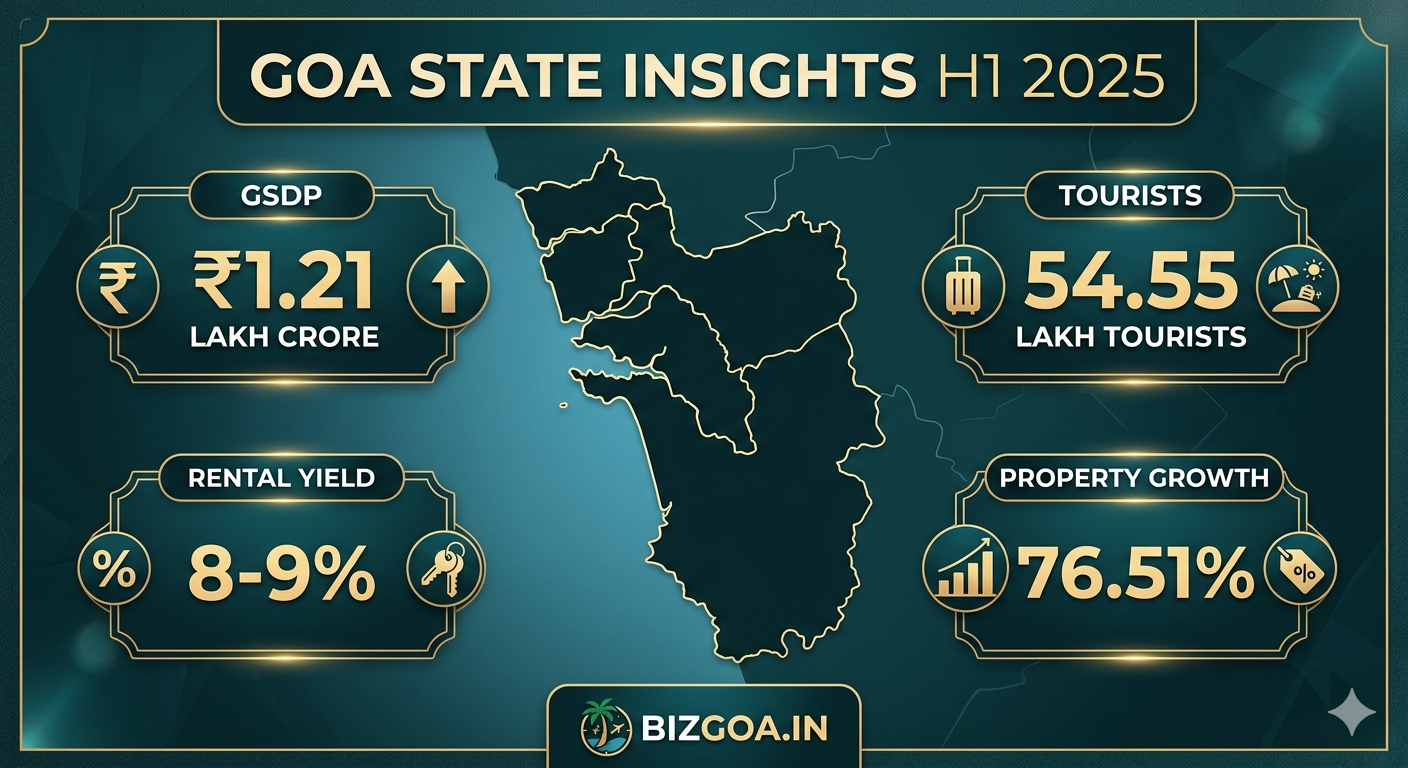
Goa's Gross State Domestic Product (GSDP) is expected to stand at ₹1,21,309 crore (approximately US$14.65 billion) in 2024–25, up from ₹1,00,002 crore in 2023–24.
The tourism industry directly contributes 16.43% to Goa's GDP and employs approximately 35% of the state's population.
Goa recorded 54.55 lakh tourist arrivals in H1 2025 alone, including 51.84 lakh domestic and 2.71 lakh international visitors.
According to DPIIT, Foreign Direct Investment inflow into Goa stood at ₹1,390 crore (US$182.16 million) between October 2019 and December 2024.
Goa's merchandise exports were valued at ₹21,445 crore (US$2.48 billion) in FY25.
Quick Snapshot
- GSDP (2024–25): ₹1,21,309 crore (~US$14.65 billion)
- Tourism contribution to GDP: 16.43%
- H1 2025 Tourist Arrivals: 54.55 lakh
- FDI Inflow (Oct 2019–Dec 2024): ₹1,390 crore
- Merchandise Exports (FY25): ₹21,445 crore
- North Goa Rental Yields: 8–9% annually
- South Goa Rental Yields: 6–8% annually
- North Goa Residential Price Growth: 76.51% in just 24 months
- IPB Projects Approved (Feb 2025): ₹733 crore generating 2,319 jobs
- PPP Projects Approved (2025): ₹25 billion
These numbers belong to a state that has quietly become one of India's highest-performing economies on a per-capita basis — and one that is only now hitting its stride.
The 7 Forces Driving Goa's Investment Surge
Force 1: Infrastructure Revolution — Two Airports, New Highways, Smart Cities
Infrastructure is the single most reliable predictor of property appreciation and business viability. Goa's infrastructure story in 2025 is among the most compelling in India.
The Mopa Airport Effect
Manohar International Airport (Mopa Airport), developed by GMR Goa International Airport Limited, commenced operations in January 2023. Its impact was immediate and seismic.
North Goa's residential prices jumped from ₹8,954 per sq. ft in JAS 2023 to ₹15,805 per sq. ft in JAS 2025, registering a striking 76.51% growth in just 24 months.
A 232-acre aerocity is planned adjacent to the airport, encompassing hotels, resorts, malls, commercial offices, and entertainment facilities. Approximately 1,500 new hotel rooms are expected near Mopa Airport by 2030.
Road Connectivity
In July 2024, a six-lane access-controlled road was inaugurated connecting Manohar International Airport to Dhargal along NH-166S, greatly improving road connectivity in the region.
The Porvorim Elevated Corridor — a six-lane, 5.2-kilometer highway — is expected to complete by April 2026, easing traffic bottlenecks along NH-66 and enhancing access to Panjim and Mopa Airport.
Smart City Investments
35 projects have been undertaken in Panaji under the Smart City Mission with a cumulative cost of ₹952.75 crore.
In September 2025, NBCC (India) Limited signed an agreement with the Government of Goa to redevelop seven key infrastructure sites with an estimated project value of ₹1,700 crore.
Every rupee of infrastructure spend accelerates real estate appreciation, reduces business logistics costs, and grows tourist arrivals — three forces that compound returns across every asset class in Goa.
Force 2: Tourism Powerhouse — 54+ Lakh Arrivals and Growing
Goa's tourism is no longer seasonal. It is structural.
The state's efforts to position Goa as a year-round destination, rather than a seasonal one, are beginning to shape investor sentiment. Wellness tourism, destination weddings, conferences, and experiential travel have become increasingly prominent, creating demand for diversified hospitality assets.
Goa reported approximately 21% growth in tourist arrivals in 2024 and a 10.5% year-on-year rise in Q1 2025.
The number of hotels registered in the state has risen sharply from 3,000 in 2022 to 9,000 in 2024, illustrating both formalization and capacity expansion.
For rental income investors, this translates directly to occupancy rates. North Goa witnesses annual rental yields between 8 to 9%, while emerging southern pockets offer returns of 6 to 8%.
Force 3: The Startup and Tech Ecosystem
This is the piece that almost all coverage misses — and it is arguably Goa's most exciting long-term investment story.
Goa is no longer just a backdrop where founders work remotely. It is building its own innovation economy from the ground up.
The Goa Startup Policy 2025 is designed to make the state a high-value destination for innovation and entrepreneurship, with 12 specific schemes including 100% IPR reimbursement for national and international patent applications.
The state's IT ecosystem is rapidly expanding through the Goa IT Policy 2021 and the Startup Promotion Cell. The IT Park at Chimbel and the Electronic City at Tuem serve as key development enablers.
The Goa government launched the Goa AI Mission 2027 to develop an inclusive, innovation-led AI ecosystem through education, startups, infrastructure, and cultural preservation.
Companies in SaaS, travel technology, health tech, content production, and e-commerce are settling in Goa because of its lower cost of operation and superior quality of life. Co-working centers and incubators have enhanced the ecosystem.
The academic institutions anchoring this knowledge economy include BITS Pilani Goa Campus, Goa Institute of Management, Goa College of Engineering, and the newly developing Electronic City at Tuem for IT and electronics manufacturing.
For startups in tourism-tech, edtech, healthtech, and green energy, Goa is now a legitimate launchpad — not just a retreat.
Force 4: Pharmaceutical and Biotech Strength
Goa is already one of India's most important pharmaceutical manufacturing states. Most investors simply do not know this yet.
The drugs and pharmaceutical commodity group accounts for USD 922.03 million — 50.58% of Goa's total export value in FY25.
Global names including Cipla, Sun Pharma, and Zydus Lifesciences have established operations here. In February 2025, the Goa Investment Promotion Board approved project expansions by Procter & Gamble and Zydus Lifesciences, expected to generate 2,319 new jobs.
The Goa Industrial Development Corporation approved over ₹100 crore in infrastructure upgrades across its 24 industrial estates in February 2025.
For MSME investors and biotech founders, the entry pathway is clear: subsidized industrial estate plots, stamp duty concessions, single-window project clearance, and capital investment subsidies for priority sectors.
Force 5: Renewable Energy — Net-Zero by 2050
Goa has made a bold, public commitment to a green economy — and that commitment is creating real, investable opportunity.
Goa aims to achieve net-zero emissions by 2050, foster a green economy, and establish itself as a model state for clean energy adoption and sustainable growth. Financial incentives, subsidies, and regulatory support will encourage private players to invest in renewable projects.
The Goa Solar Policy encourages private developers to build utility-scale solar parks in areas like Sanguem, Quepem, and Canacona. Homeowners and institutions can install systems up to 1 MW capacity, with subsidies of up to 40% for systems up to 3 kW under MNRE and GEDA programs.
The sectors with immediate investment potential here include solar installation services, green architecture, EV charging infrastructure, sustainable hospitality construction, and climate-tech startups.
Force 6: The Real Estate Boom — Yields, Appreciation, and NRI Demand
This is Goa's most-publicized investment story — and the numbers more than justify the attention.
Villa capital values in prime locations rose 22% between FY2023 and FY2024, with rental yields also strengthening.
Property registration in North Goa surged by 48% from 2021 to 2024, driven by infrastructure improvements, NRI investment, and improved ease of doing business.
Over the past two years, luxury housing demand in Goa has increased by 39.69%, led by HNIs, NRIs, and lifestyle investors. The launch of Mopa International Airport is spurring land value increases of 27–30% year-over-year in surrounding areas.
For NRI investors specifically, Goa delivers four compounding advantages:
- High rental yields: 5–9% annually depending on location and property type
- Strong capital appreciation: 20–40%+ over 3–5 years in prime corridors
- Ease of management: professional full-service property management is widely available
- Emotional anchor: a tangible, FEMA-compliant base in India with world-class lifestyle
For NRIs, Goa's luxury villa market has emerged as one of the most rewarding avenues for portfolio diversification. Well-designed villas in prime locations are commanding robust short-term rental demand, allowing owners to enjoy both personal use and consistent income.
Force 7: Quality of Life Premium — The Intangible Edge
Every experienced investor knows that quality of life is not a soft metric. It is a business advantage that shows up directly in operating costs, talent retention, and long-term asset demand.
Goa holds India's highest literacy rate at over 88%. It ranks among India's top states on the Human Development Index. Its per capita income sits among the nation's highest.
Safety indicators in 2025 — especially low crime rates — show encouraging improvement, giving long-stay residents the confidence they look for in a permanent base. Air quality remains steady and comfortable across much of the state, offering a healthier everyday environment than most large Indian cities.
For founders and business investors, Goa's lifestyle premium translates into lower employee attrition, easier senior talent recruitment from metros, reduced founder burnout, and a genuinely open, multicultural professional community that attracts global talent organically.
Goa's $110 Billion Vision: The Economic Ambition
The state government and economic planners have set a bold target of achieving a GDP of $110 billion by 2035 — representing an almost tenfold increase from current levels within just a decade.
As of 2025, Goa's GDP is estimated at $11 to $12 billion. While this reflects the state's small geographical footprint, it highlights unique economic composition and enormous growth potential.
To reach that vision, Goa is making strategic bets across five emerging economies running in parallel:
- The Knowledge Economy — IT, biotech, AI, and higher education
- The Blue Economy — marine technology, port logistics, sustainable fisheries
- The Green Economy — renewable energy, eco-tourism, sustainable manufacturing
- The Experience Economy — luxury hospitality, wellness, cultural tourism
- The Digital Economy — e-governance, fintech, and travel-tech platforms
For investors, this vision matters because it signals a decade of sustained government commitment to infrastructure, policy support, and sector development. Investing in alignment with a state's official growth roadmap is one of the most reliable ways to reduce long-term investment risk.
Sector-by-Sector Investment Guide
1. Luxury Real Estate and Second Homes
- ROI Potential: 20–40% capital appreciation over 3–5 years, plus 6–9% annual rental yield
- Minimum Entry: ₹1.5 crore (plot) to ₹5 crore+ (luxury villa)
- Best Areas: Anjuna, Assagao, Morjim, Siolim, Arpora in North Goa; Colva, Benaulim, and Cavelossim in South Goa
- Rental Model: Short-term Airbnb-style lets during the October–February peak season; long-term leasing for year-round stability
- Best For: HNIs, NRIs, lifestyle investors
2. Boutique Hospitality
- ROI Potential: 12–18% gross yield for well-managed boutique properties
- Options: Eco-resorts, wellness retreats, heritage homestays, boutique hotels, glamping sites
- Policy Support: Goa's tourism policy actively supports small-format hospitality operators with single-window approvals and government grants for heritage property restoration
- Best For: Founders, lifestyle entrepreneurs, HNIs with operational appetite
3. IT and Tech Startups
- ROI Potential: Equity-based; early-mover advantage in an under-crowded ecosystem
- Key Enablers: Goa IT Policy 2021, Startup Policy 2025, Startup Promotion Cell, IT Park at Chimbel, Electronic City at Tuem
- Focus Sectors: Software development, digital marketing, AI-driven tourism platforms, SaaS, and e-commerce services are all expanding rapidly
- Best For: Founders, angel investors, early-stage VC funds
4. Pharmaceutical and Biotech
- ROI Potential: Steady industrial returns with government cost subsidies reducing effective investment
- Entry Pathway: Industrial estate plots through Goa-IDC, pharma cluster at Verna, Startup Policy incentives for biotech
- Opportunity Gap: Nutraceuticals, medical devices, clinical research organizations, and pharma logistics are all underpenetrated
- Best For: MSME manufacturers, biotech founders, pharmaceutical distribution investors
5. Renewable Energy
- ROI Potential: 10–15% IRR for well-structured solar and green energy projects
- Policy Support: Goa Solar Policy with up to 40% subsidies; net-zero 2050 commitment; IREDA project approvals
- Best Areas: Sanguem, Quepem, and Canacona for utility-scale solar; rooftop solar across the entire state
- Best For: Institutional investors, infrastructure funds, green tech entrepreneurs
6. Logistics and Warehousing
- ROI Potential: 8–12% yield on commercial logistics assets
- Opportunity Driver: Mormugao Port expansion, rising tourism supply chain, e-commerce penetration in Goa
The state continues to actively welcome logistics and warehousing investments beyond the tourism sector, with PPP project approvals signalling strong commitment to infrastructure-led growth.
- Best For: Institutional investors, supply chain entrepreneurs, port-linked commerce players
7. Food Processing and Agri-Business
- ROI Potential: Variable depending on product and scale; strong export potential
- Key Products: Cashew processing, seafood exports, coconut derivatives, spice processing, organic produce
- Government Support: Subsidies available under Goa's industrial and MSME policy for food processing units
- Best For: MSME founders, agri-entrepreneurs, export-focused manufacturers
Area-by-Area Investment Map: North Goa vs South Goa
North Goa: High Appreciation, Premium Lifestyle
North Goa is the undisputed star of Goa's investment story right now. The Mopa Airport effect has compressed appreciation timelines dramatically.
Pernem and Tuem
Located 10–15 minutes from Mopa Airport, this corridor is the most infrastructure-driven growth zone in Goa. IT and electronics manufacturing cluster development at Tuem adds a commercial demand layer beyond tourism. Price range: ₹12,000–₹40,000 per sqm. Best for early-stage land banking and industrial plots.
Assagao and Anjuna
The premium lifestyle corridor of North Goa. Home to Goa's most vibrant expat community, the finest restaurants, design studios, and co-working spaces. Luxury villa prices range from ₹15,000–₹60,000 per sqm. Best for luxury villa investment and boutique hospitality.
Siolim and Arpora
Arpora is a hidden gem surrounded by lush greenery yet close to North Goa's vibrant lifestyle. Buyers seeking sophistication and privacy are turning to this area. Price range: ₹12,000–₹50,000 per sqm. Best for boutique hospitality and premium residential.
Morjim and Ashwem
Coastal belt with direct beach access and strong eco-tourism demand. Growing popularity among wellness investors and premium villa buyers. Price range: ₹14,000–₹55,000 per sqm.
Porvorim
Goa's emerging commercial and IT office hub. Excellent connectivity to Panjim and the airport. Price range: ₹10,000–₹35,000 per sqm. Best for commercial office space and mixed-use development.
South Goa: Stability, Lower Entry, Industrial Depth
South Goa offers a different but equally compelling investment case — lower entry prices, stable yields, and strong industrial fundamentals.
Colva and Benaulim
Classic South Goa beach belt. Stable rental demand, family-friendly environment, lower price points than North Goa. Price range: ₹8,000–₹30,000 per sqm. Best for steady rental income and family second homes.
Cavelossim and Varca
South Goa is witnessing a strong wave of premium development and buyer interest. Cavelossim in particular is seeing luxury resort development and high-end villa construction. Price range: ₹10,000–₹35,000 per sqm.
Verna Industrial Estate
Goa's most important industrial hub. Home to pharmaceutical majors, electronics manufacturers, and FMCG companies. Best for industrial plot investment, manufacturing setup, and commercial logistics. Price range: ₹8,000–₹25,000 per sqm.
Margao
The commercial capital of South Goa. Strong retail, office, and residential demand from local professionals. Price range: ₹6,000–₹18,000 per sqm. Best for commercial real estate and retail investment.
Key Insight: North Goa delivers higher appreciation potential. South Goa delivers greater stability, better value entry points, and strong industrial fundamentals. A well-constructed Goa investment portfolio should ideally hold assets in both regions.
NRI Investment Framework: Legal, FEMA, and Process
If you are an NRI planning to invest in Goa, understanding your legal framework is not optional. It is the foundation of safe investing.
What NRIs Can Buy in Goa
NRIs are permitted to purchase non-agricultural residential plots, residential apartments and villas, commercial properties, and industrial properties through appropriate business entities.
NRIs cannot directly purchase agricultural land (except through inheritance), plantation land, or farmhouses (direct purchase restriction applies).
Source: Foreign Exchange Management Act (FEMA), Reserve Bank of India guidelines
Key Compliance Steps for NRI Property Purchase
- Verify RERA registration at rera.goa.gov.in before committing to any property.
- Obtain an Encumbrance Certificate for the full look-back period to confirm no pending dues or litigation.
- Check CRZ (Coastal Regulation Zone) compliance for any property within 500 metres of the high-tide line.
- Verify land use classification through the Goa TCP (Town and Country Planning) online portal.
- Conduct a title verification with an independent local legal counsel — not just the developer's lawyer.
- Use NRI-eligible home loans from Indian banks. SBI, HDFC, ICICI, and Axis Bank all offer NRI-specific products for Goa property.
- Understand repatriation rules. Rental income repatriation is permitted under RBI guidelines up to the net income after Indian taxes.
Tax Benefits for NRI Investors
Home loan interest is deductible under Section 24(b) of the Income Tax Act. Principal repayment qualifies under Section 80C. Long-term capital gains benefits are available under Section 54 on reinvestment of proceeds. Goa also levies minimal annual property tax on residential use compared to most major Indian cities.
Always engage a FEMA-compliant CA or legal advisor before executing any investment.
How to Invest in Goa: Step-by-Step Guide
Whether you are an HNI, an NRI, or a founder building a business, here is a practical, actionable roadmap.
Step 1: Define Your Investment Objective
Decide first what you want this investment to do. Options include capital appreciation through land banking, regular income through rental yield, business establishment as a startup or MSME, or a hybrid lifestyle-plus-returns play through a second home.
Step 2: Choose Your Sector and Micro-Market
Use the sector and area breakdowns above. Match your budget, risk tolerance, and investment timeline to the right asset type and location before approaching any developer or agent.
Step 3: Conduct Independent Due Diligence
For real estate, engage a RERA-registered independent agent — not the developer's agent. Verify title, CRZ status, TCP zoning, and Encumbrance Certificate independently. Confirm no pending litigation through a title search.
For business investment, verify the business registration requirements, apply to Goa Startup Policy 2025 schemes if eligible, and engage with Goa-IPB's single-window clearance desk.
Step 4: Secure Your Financing
NRI home loans are available from SBI, HDFC, ICICI, and Axis Bank. Business loans are available via SIDBI and the MSME credit guarantee scheme. Equity funding is emerging from Goa's growing angel investor network.
Step 5: Register Your Investment
Property registration happens at the Sub-Registrar's office. Company registration uses the MCA portal or Goa-IPB's single-window system. GST registration is required if you are operating a business.
Step 6: Activate and Optimize Your Investment
For rental property, engage a professional property management company from day one. For startups, register with the Startup Promotion Cell and access incubation and funding support. For manufacturing, apply for industrial estate plot allocation through Goa-IDC.
Step 7: Connect with BizGoa.in
Register your business, property, or investment offering on BizGoa.in to reach Goa's most active community of investors, entrepreneurs, and decision-makers. Local visibility is your most underrated competitive advantage in Goa's relationship-driven market.
Goa vs Other Indian Investment Destinations
Investors often ask: why Goa over a proven metro market? Here is the honest, data-driven answer.
Goa vs Mumbai
Mumbai offers real estate appreciation of approximately 15–25% over three years with rental yields of just 2–3%. Goa delivers 40–76% appreciation over the same period with yields of 6–9%. Mumbai's cost of living and operating costs are dramatically higher. Mumbai wins on startup ecosystem maturity and VC access. Goa wins on yield, lifestyle, and value.
Goa vs Bangalore
Bangalore is India's startup capital — no argument there. But for a founder seeking a quality-of-life base outside Bangalore's traffic, pollution, and sky-high rents, Goa offers lower operating costs, better air quality, and first-mover advantage in tourism-tech, wellness-tech, and green energy sectors that Bangalore has not yet dominated.
Goa vs Hyderabad
Hyderabad offers strong appreciation (25–40% over three years) and government incentives comparable to Goa. However, Goa adds a tourism economy layer, NRI demand for real estate, and a rental yield profile (6–9%) that Hyderabad cannot match. For diversification, Goa and Hyderabad serve different risk-return profiles.
Goa vs Kochi
Both are quality-of-life destinations with growing startup scenes and strong tourism economies. Goa edges ahead on real estate appreciation, NRI real estate demand, and the specific tourism-led rental income opportunity. Kochi has a slightly more mature tech talent pool. Both deserve space in a diversified portfolio.
Bottom Line: Goa outperforms major metros on yield, appreciation, quality of life, and lifestyle value. It carries slightly higher concentration risk due to tourism dependency — but government diversification efforts across pharma, IT, logistics, and renewable energy are actively and measurably reducing that risk.
Risks to Know and How to Manage Them
No investment is risk-free. Here is an honest assessment — and how experienced investors manage each one.
Risk 1: Seasonal Demand Fluctuation
Tourism peaks from October to February. Rental income drops significantly during the monsoon months of June to September. Mitigation: Target year-round tenants including digital nomads, long-stay professionals, and wellness tourists. Invest in areas with commercial demand beyond seasonal tourism.
Risk 2: Land Title Complexity
Goa's land records carry historical complexity from Portuguese-era titles, communidade land systems, and CRZ boundary disputes. Mitigation: Always engage an independent local lawyer — not the developer's counsel. Obtain an Encumbrance Certificate. Verify land use through the TCP portal before signing anything.
Risk 3: CRZ and Environmental Regulations
Goa's coastal zones are subject to strict Coastal Regulation Zone rules. Building violations can lead to demolition orders and financial penalties. Mitigation: Only invest in fully RERA-compliant, CRZ-cleared properties. Avoid off-plan purchases without verified approvals already in place.
Risk 4: Infrastructure Delivery Delays
Government infrastructure projects in India rarely run precisely on schedule. Mitigation: Invest in areas served by already-operational infrastructure — Mopa Airport, the NH-166S six-lane road, and the Zuari Bridge — rather than speculative future connectivity.
Risk 5: Tourism Concentration Risk
Goa's economy is still heavily weighted toward tourism. A major disruption — pandemic, extreme weather, geopolitical events — can affect multiple asset classes simultaneously. Mitigation: Diversify across sectors. Consider an industrial or tech-focused asset alongside hospitality investments to reduce single-sector exposure.
Risk 6: Regulatory and Zoning Changes
Development control regulations can change with new administrations or Regional Plan revisions. Mitigation: Monitor the Goa Regional Plan and Town and Country Planning Department updates actively. Engage a local legal advisor on retainer to stay current.
Expert Tips from the Ground
Tip 1: Buy Where Infrastructure and Tourism Overlap
The biggest returns in Goa come from micro-markets where both tourism demand and infrastructure improvement converge simultaneously — not just one or the other. The NH-166S and Mopa Airport corridor is the textbook example in 2025–26.
Tip 2: Match Your Product to the Demand
Different Goa sub-markets have different renter profiles. A studio or one-bedroom flat suits 30–60-day digital nomad stays. A two- or three-bedroom villa suits premium weekly rentals. A large farmhouse plot suits buy-and-hold land appreciation. Match the product to the underlying demand rather than just the location.
Tip 3: Look South When North Gets Priced Out
South Goa is witnessing a strong wave of premium development and buyer interest. As North Goa's premium zones hit saturation pricing, South Goa's emerging corridors offer better entry points and stronger relative upside for patient investors.
Tip 4: NRIs Must Build a Management Plan Before They Buy
Credible developers in Goa who offer comprehensive management, maintenance, and rental services under one roof have made the ownership experience remarkably seamless for NRIs. Never purchase without a property management plan agreed and in writing before the transaction closes.
Tip 5: Founders — Your Window Is Still Open, But Not for Long
Goa offers an emerging startup ecosystem with early-mover advantage, especially in tech, creative industries, tourism-tech, and sustainability — sectors where the ecosystem is still forming rather than fully formed. That window is open now. It will not remain open forever.
Tip 6: Use BizGoa.in as Your Local Intelligence Layer
Before making any investment decision in Goa, use BizGoa.in's directory to identify active businesses, service providers, and co-investors already operating in your target sector and location. Local intelligence is your most underrated advantage in Goa's relationship-driven market.
Mistakes to Avoid When Investing in Goa
- Buying agricultural land as an NRI. This is illegal under FEMA. Do not let any agent or developer convince you otherwise.
- Skipping CRZ verification. Even the most beautiful beachside plot can be a legal minefield if it sits inside a CRZ zone without proper clearances.
- Relying solely on the developer's legal team. Always commission an independent legal opinion from a FEMA-compliant counsel of your own choosing.
- Building a cash flow model on peak-season rentals only. If your investment plan depends entirely on November-to-February occupancy, your projections will consistently disappoint.
- Chasing low entry prices without checking land use. Speculative agricultural plots sold with conversion promises have burned multiple investors. Verify TCP zoning before signing.
- Investing without a property management plan. A Goa villa managed remotely without professional on-ground support will underperform on both occupancy and maintenance — every time.
- Putting all capital into one micro-market. Goa is small but diverse. Spreading across North and South Goa, and across different asset types, meaningfully reduces concentration risk.
- Ignoring the commercial and startup opportunity. Real estate is the obvious play in Goa. But Goa's tech, pharma, and green energy sectors offer superior risk-adjusted returns for the right investor profile — and far less competition.
Best Practices for Investing in Goa
- Always invest in RERA-compliant properties and verify at rera.goa.gov.in before any commitment.
- Engage a FEMA-compliant legal advisor for all NRI transactions.
- Visit and physically inspect the property before signing any agreement.
- Commission an independent valuation from a certified property valuator, not just the developer's quote.
- Diversify across micro-markets and asset classes to manage concentration risk.
- Plan for a minimum 3–5 year hold period on real estate for realistic appreciation capture.
- Register your business or investment listing on BizGoa.in for local market access and visibility.
- Stay updated on Goa's Regional Plan revisions through the Town and Country Planning Department.
- Track the Goa Investment Promotion Board's project approval announcements for early sector signals.
- Connect with the Goa Chamber of Commerce and Industry for business investment networking and regulatory guidance.
Summary and Investment Checklist
Why Goa Is India's Next Investment Hotspot — Quick Recap
Goa offers something almost no other Indian state can match: a full-stack investment case that works simultaneously for multiple investor profiles.
- For real estate investors: 20–76% appreciation and 6–9% rental yields with professional management available.
- For startup founders: Goa Startup Policy 2025, AI Mission 2027, IT Policy 2021, and an uncrowded ecosystem with early-mover advantage.
- For NRIs: FEMA-compliant property ownership, strong appreciation, rental income repatriation, and a lifestyle base that metro cities simply cannot offer.
- For pharma and industrial investors: An established export-oriented cluster, 24 industrial estates, global players already anchoring the ecosystem, and active government subsidies.
- For renewable energy players: A clear net-zero 2050 policy, solar subsidies up to 40%, and a state government actively soliciting green investment.
- For hospitality entrepreneurs: 54+ lakh annual tourists, growing year-round demand, and a formalization wave creating space for quality operators.
Pre-Investment Checklist
Before you invest in Goa, work through this list:
- Define your investment objective clearly — appreciation, yield, business, or hybrid
- Select your target sector and micro-market based on your profile
- Verify RERA compliance for any property investment at rera.goa.gov.in
- Check CRZ status for any coastal or near-coastal property
- Obtain an independent Encumbrance Certificate
- Verify land use classification through the Goa TCP portal
- Engage a FEMA-compliant legal advisor if you are an NRI
- Agree on a property management arrangement before completing purchase
- Register with the Goa Startup Promotion Cell if establishing a startup
- Connect with Goa-IPB for single-window clearance on industrial or commercial projects
- List your business or investment on BizGoa.in for local visibility and connections
Conclusion: The Window Is Open — But Not Indefinitely
The conversation about Goa as a serious investment destination is no longer speculative. It is now backed by data, policy, infrastructure, capital flows, and a decade of rising arrivals that show no signs of reversing.
2025 marks the beginning of a new era for homeowners and investors in Goa.
Goa's economic expansion is a sign of a larger shift from a tourist-based economy to a multi-sectoral model. Ease of doing business has improved, digital governance has advanced, and focused investment policies are boosting the confidence of all stakeholders.
But windows do not stay open forever. North Goa's premium zones are already 76% more expensive than they were 24 months ago. The startup ecosystem is attracting founders who will define the next wave. Industrial plots in the best-connected estates are moving. The investors who will look back on this decade with the greatest satisfaction are the ones who moved while the opportunity was still in its early innings.
Your next step starts here.
Start Your Goa Investment Journey with BizGoa.in
BizGoa.in is Goa's most comprehensive business and investment directory — connecting investors, founders, NRIs, and entrepreneurs with Goa's growing economy every day.
- Discover verified businesses, services, and investment opportunities across every sector in Goa.
- Explore Goa's investment zones by category, location, and business type.
- List your business or investment offering to reach thousands of active searchers and decision-makers.
- Connect with local partners, suppliers, agents, and co-investors who are already building in Goa.
Explore Investment Opportunities on BizGoa.in
List Your Business on BizGoa.in
Browse All Goa Business Categories
Published by BizGoa.in — Goa's trusted business and investment discovery platform. All data cited from authoritative sources including IBEF, Invest India, DPIIT, MagicBricks, Housing.com, Goa Investment Promotion Board, and official Government of Goa publications.
Frequently Asked Questions
Q1. Is Goa a good investment destination in 2025–26?
Yes. Goa offers strong real estate appreciation (20–76% in recent years), high rental yields (6–9%), a growing tech and pharma ecosystem, government investment incentives, and one of India's highest quality-of-life scores.
Q2. What sectors should I invest in Goa?
The top sectors are luxury real estate, boutique hospitality, IT/SaaS startups, pharmaceuticals and biotech, renewable energy, logistics and warehousing, and food processing. Each offers different risk-return profiles suited to different investor types.
Q3. Can NRIs buy property in Goa?
Yes. NRIs can purchase non-agricultural residential and commercial properties in Goa under FEMA guidelines. They cannot directly purchase agricultural land. All properties should be RERA-verified and CRZ-compliant.
Q4. What are the rental yields in Goa?
North Goa yields 8–9% annually (Housing.com data), while South Goa yields 6–8%. Premium short-term rental villas near the beach and Mopa Airport can achieve higher blended yields during the October–February peak season.
Q5. Which area is best for investment in Goa?
North Goa (Anjuna, Assagao, Morjim, Siolim, Pernem) offers the highest appreciation potential. South Goa (Colva, Benaulim, Cavelossim) offers stability and lower entry prices. Industrial investors should look at Verna and Tuem.
Q6. How has the Mopa Airport affected Goa property prices?
North Goa residential prices rose 76.51% in 24 months following Mopa Airport's launch (January 2023). Land near the airport corridor (Pernem, Morjim, Mandrem) is appreciating at 27–30% year-on-year.
Q7. What is the Goa Startup Policy 2025?
It is the Government of Goa's flagship startup incentive framework with 12 schemes, including 100% IPR reimbursement, seed funding support, co-working subsidies, and market access assistance for registered startups.
Q8. What is Goa's GDP target for 2035?
The Goa state government has set a bold target of $110 billion GDP by 2035, up from the current estimated $11–12 billion. This requires sustained multi-sector growth across tech, tourism, manufacturing, and the blue economy.
Q9. Is Goa safe for long-term investment?
Yes. Goa is one of India's most politically stable and legally robust states. Property registration is digitized, RERA is operational, and the Investment Promotion Board provides single-window clearance for business projects.
Q10. What is BizGoa.in and how can it help investors?
BizGoa.in is Goa's leading business directory and investment discovery platform. It connects investors, NRIs, and founders with verified local businesses, service providers, and investment opportunities across all sectors and regions in Goa.
Q11. What are the tax benefits of investing in Goa real estate?
NRIs can claim home loan interest deductions under Section 24(b) and principal deductions under Section 80C. Long-term capital gains benefits are available under Section 54 on reinvestment. Goa also has minimal annual property tax for residential use.
Q12. What is the minimum investment to enter Goa's real estate market?
Plotted land starts at approximately ₹50–75 lakh in emerging South Goa corridors. North Goa prime villas start at ₹1.5–2 crore. Commercial properties vary. Budget entry points are available in industrial estate plots through Goa-IDC.
Q13. How do I register a startup in Goa?
Register with the Goa Startup Promotion Cell, obtain a Startup Certificate, and apply for schemes under the Goa Startup Policy 2025. Business registration is done via the MCA portal or Goa-IPB's single-window clearance.
Q14. Does Goa offer renewable energy investment opportunities?
Yes. The Goa Solar Policy provides subsidies up to 40% on rooftop solar. The state is targeting net-zero emissions by 2050 and is actively soliciting private investment in solar parks, EV infrastructure, and green construction.
Q15. How does Goa compare to Bengaluru for startup investment?
Goa offers lower operating costs, better quality of life, and early-mover advantage in emerging sectors like tourism-tech, wellness-tech, and green energy. Bengaluru offers a more mature ecosystem with deeper VC access. Goa is ideal for lifestyle-led founders; Bengaluru for scale-at-speed models.